/filters:quality(90)/fit-in/970x750/coros-web-faq/upload/images/41dee13f2332545ccee06223c807a768.jpg)
What Is Running Fitness?
Running Fitness refers to the absolute value of your running ability (from a scale of 40-100) to help better understand your strengths and areas for improvement as a runner. There are four individual abilities assessed in the COROS app. Let's review them below:
- Base (>30km): Aerobic Endurance is your ability to perform prolonged low-intensity exercise. We use the lowest pace in the Aerobic Power zone as an evaluation criterion. The higher the pace, the stronger the aerobic endurance!
- Endurance (~10km): Lactate Threshold Endurance is your ability to perform moderate to high-intensity exercise. We use your Threshold Pace as evaluation criteria. A faster pace means a better Lactate Threshold.
- Speed (~3km): Speed is your ability to perform high-intensity exercise. We use VO2 max as evaluation criteria. The higher the value, the faster you can sustain those high-intensity running bouts!
- Sprint (~400m): Sprint is your ability to perform short, very high-intensity exercise. We use the highest pace you can achieve in 30-60s as an evaluation standard. The higher the pace, the stronger the Anaerobic Endurance!
The COROS EvoLab algorithm calculates these abilities based on your last six weeks of training data. Each day, your runs are factored into the calculations, and old data from beyond six weeks ago is removed. This doesn't mean you'll see changes every day, though. Fitness is gained and lost slowly, so your Running Fitness will be slow to move as well.

Running Fitness overview from the COROS app
How To Interpret Your Running Fitness
Because each category has its evaluation criteria, it becomes easier to get a clearer picture of your running abilities. For example, here are two profiles with various Running Fitness abilities:
- Athlete A focuses on middle-distance events, which explains the higher values within the Endurance and Speed categories.
- Athlete B focuses on ultra distances (>50km), which explains the higher score in the Base category.
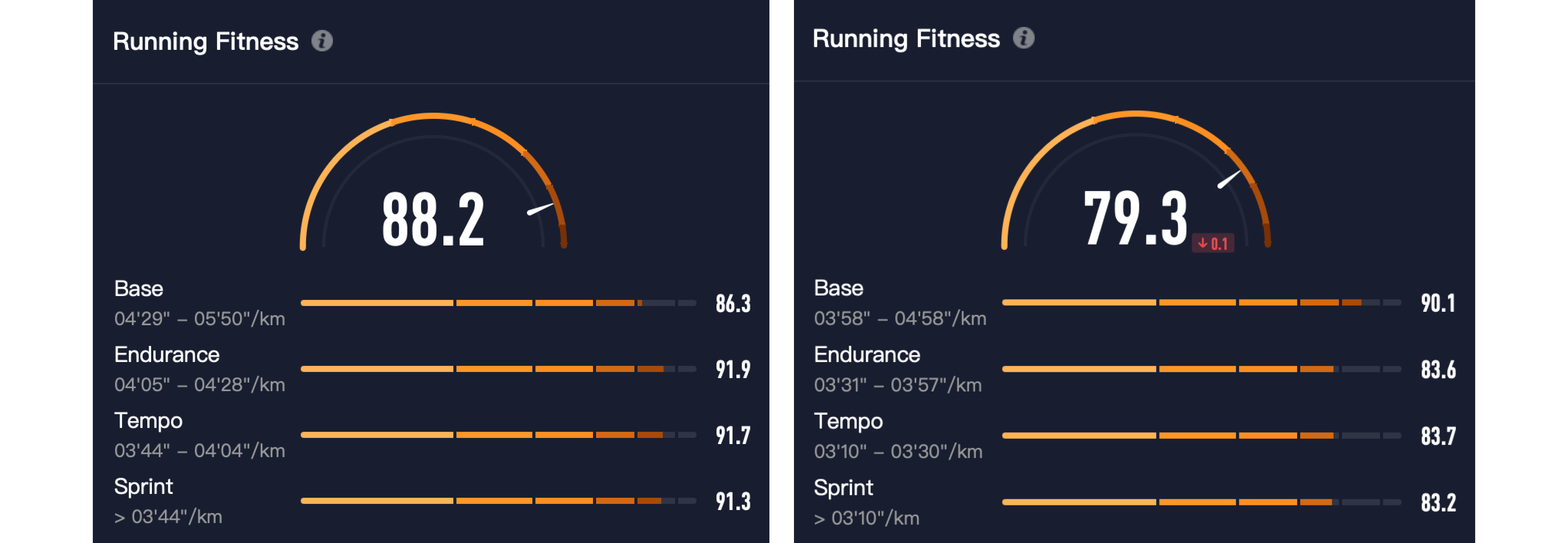
Athlete A (left) vs Athlete B (right)
The paces associated with each category are the intensities at which you should run at to improve this given category. After identifying your areas of improvement, aim to increase your training time within this pace zone to improve more effectively.
EvoLab Connections
Your Running Fitness value is the core of the COROS EvoLab algorithm. It is the foundation for nearly all of the long-term data that COROS provides, including:
Race Predictor: This widget, found on your watch, the app, and Training Hub, uses your current fitness calculations to estimate your 5K, 10K, Half Marathon, and Marathon race times. As your Running Fitness improves, so do your predictions, giving you a real-time gauge of your progress. These predictions are based on ideal weather and course conditions, so if you're running a hilly or hot race, you'll want to adjust your expectations accordingly.
Pace Zones: Similar to the four contributing factors of Running Fitness, EvoLab will also provide training paces for your six intensity zones. Learn more about how to train using pace zones in this article!
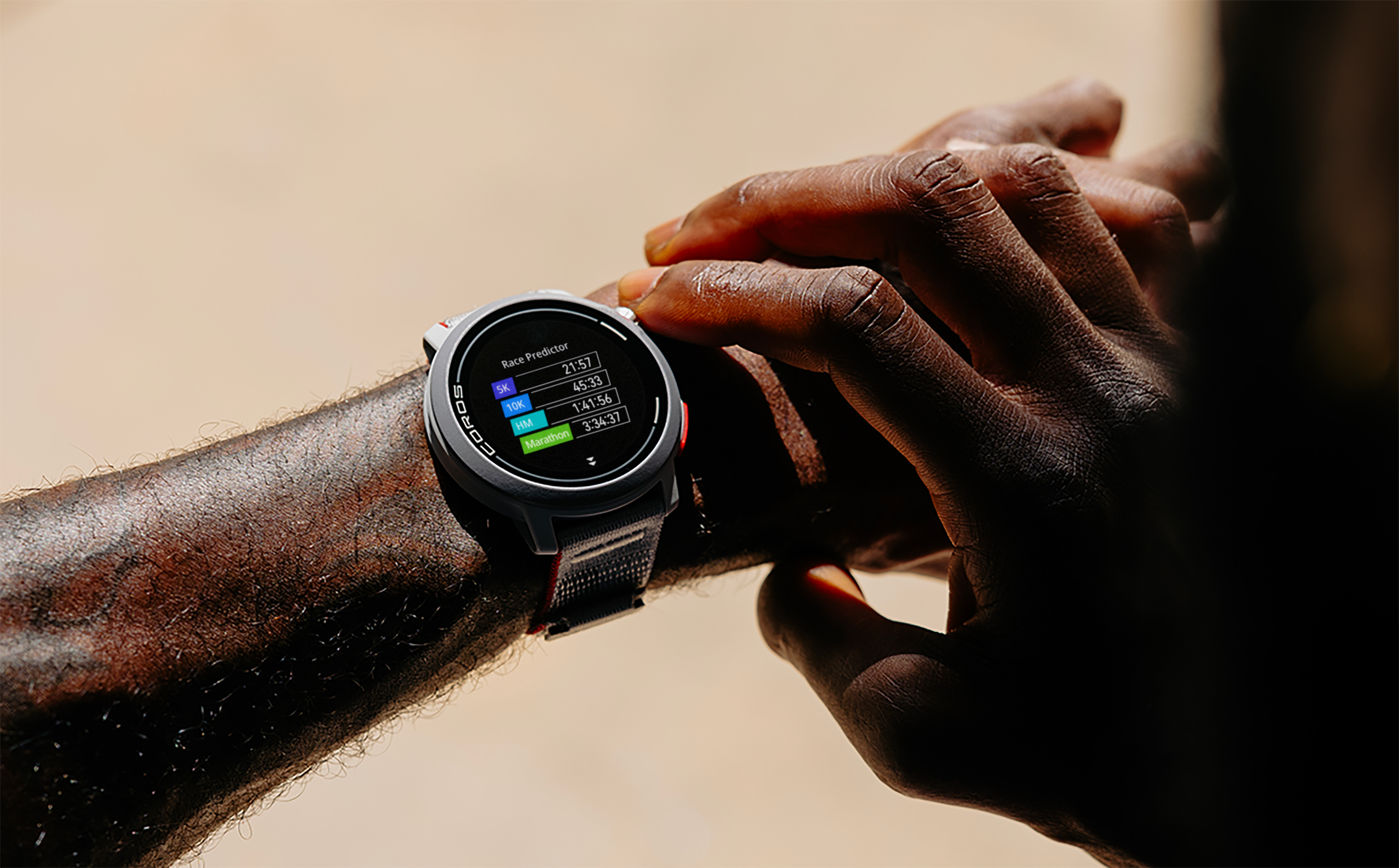
The COROS Race Predictor on the PACE Pro
How to Improve Your Running Fitness
As mentioned above, each category has its evaluation criteria. Although they are all related in some way, Running Fitness allows you to focus on one component during training. Let's break down coaching strategies for each category with their criteria:
Base (Lowest pace in the Aerobic Power zone)
We suggest spending some time in the Aerobic Endurance zone to improve this ability. Continuous long-duration (1-2 hours) training in this zone will increase mitochondrial content and improve your aerobic base.
Endurance (Threshold Pace)
We suggest spending some time in the Threshold zone to improve this ability. Long intervals (15-30min) in this zone will delay your threshold turnaround point and ultimately make you run faster for longer!
- Effort Pace - Beginner Threshold Development Workout
- Effort Pace - Advanced Threshold Development Workout
Speed (VO2max)
We suggest spending some time in the Anaerobic Endurance zone to improve this ability. Short intervals (3-7min) in this zone are ideal for inducing a high VO2 and ultimately contribute to improving your running VO2 max.
- Effort Pace - Beginner VO2 max Development Workout
- Effort Pace - Advanced VO2 max Development Workout
Sprint (Fastest pace for 30s-60s)
We suggest spending some time in the Anaerobic Power zone to improve this ability. Short sprint bouts are ideal for improving your running form and your overall short-distance performance.