/filters:quality(90)/fit-in/970x750/coros-web-faq/upload/images/14ea5b89d7b4cfe99f3ec2185b33617c.png)
There's a moment in every young runner's career where the competition changes. The fields get deeper. The pace gets honest. And for the first time, you're not the one doing the pushing; you're the one trying to hang on.
For Jaelyn Williams, that moment came on a whirlwind trip to the East Coast, where she lined up against some of the best middle- and long-distance talent in the country at the New Balance Grand Prix in Boston and the Millrose Games in New York, all within the span of a few days.
It was her first time racing on the East Coast. It was her first time on an indoor track. And she came home with performances that put her among the best high schoolers in U.S. history.
Watch: COROS PACE 4
Accessory: COROS Heart Rate Monitor
Analysis: Training Hub
Building the Base
Williams' indoor performances didn't come out of nowhere. Heading into the season, her focus was on building a foundation for the outdoor season ahead.
"I'm doing a little bit more threshold right now and I'm just trying to build up my mileage to build a strong enough base," Williams said. Her weekly structure has been straightforward: threshold sessions, easy runs, and a long run. No frills or cross-training. Just running.
That simplicity extends to her strength work, too. Rather than loading up in the gym, she's been targeting specific areas with her coach to improve her running form. They've made small adjustments to her kick and arm swing that will make her more efficient when it matters most.
"My form's alright, but there's a few things that I can make more efficient," she said. "My kick, my arms, things like that."
Running Smart with Heart Rate
One tool that's played a key role in keeping Williams' training on track is her COROS Heart Rate Monitor. For her, it's less about chasing data and more about making sure her easy days are actually easy.
"It helps me make sense of how well my body is recovering and how difficult the runs feel," she explained. "I don't want my easy runs to be anaerobic or threshold. I want them to be stressing my body in the right way instead of being like, 'oh, this pace seems easy,' and it's actually too fast."
It's a mature approach for a high school athlete. Understanding that what feels easy and what is easy isn't always the same thing. Her heart rate data keeps her honest, ensuring the hard days are hard and the recovery days actually promote recovery.
A New World: The 3K in Boston
The Terrier Invite 3K was unlike anything Williams had experienced. No high school rivals. No championship title on the line. Just a fast field of college and professional runners, a pacer, and 15 laps around a banked indoor track she'd never set foot on before.
"There was no pressure like, 'oh, you have to win this certain title,'" Williams said. "It was just nice to be pushed by the girls and just dragged along. Really just see what I can do and let them take me."
She settled into the lead pack early and held on for most of the race, distributing her effort evenly throughout. When the leaders kicked with two laps to go, she didn't have the gears to go with them, but the result was still one of the fastest 3K performances in high school history.
"I'd say one of the things I wish I had done differently was have a better kick at the end," she reflected. "I was kind of just trying to make it to the end the last two laps."
It's the kind of learning that only comes from racing at that level. It's also exactly the type of experience that she's been missing. Experience that will set her up for success next time.
Back-to-Back: The Mile at Millrose
With the 3K in her legs and a train ride from Boston to New York behind her, Williams had less than 24 hours to recover before toeing the line in the mile at the Millrose Games — one of the most iconic indoor meets in the world.
Her legs weren't completely fresh, but her mindset was. "I wasn't really thinking about how I PR'd in the 3K before and how tired I was," she said. "At the end of the day, you're still going to be in the same conditions whether you worry about it or not. So I just pushed those worries out of my mind and focused on my goals for this race."
After years of racing the mile and two-mile on the same day, or a 4x800 and open events, Jaelyn was prepared for exactly this kind of situation.
When a competitor took the race out hard from the gun, Williams stayed patient. She kept herself in the lead group, biding her time. With roughly 600 meters to go, she made a move, working to close the gap on the leader. She caught her with about 200 to go, but was caught at the line by another competitor in a razor-close finish.
"I did not see her coming up on me that last 100," Williams admitted. "I partially let up. Not completely, but I didn't run through the line at top speed. It was kind of cruise control."
It was another lesson learned: in indoor racing, where the margins are measured in fractions, you run through the line. Every time.
The Indoor Revelation
Despite never having raced on an indoor track before these two meets, Williams discovered something surprising: she loves it.
"It's so tactical that your mind has to be in the game the whole time," she said. "For me, that's really good because it keeps my mind busy. There's always something to be focused on."
She pointed to the energy of racing in a compact space. The crowd stacked on top of you. The banked turns where nobody dares make a move. The constant awareness of positioning on a tiny oval.
"There's so much energy and everything is so dense and compact. You feel a lot of support from the crowd."
Looking Ahead
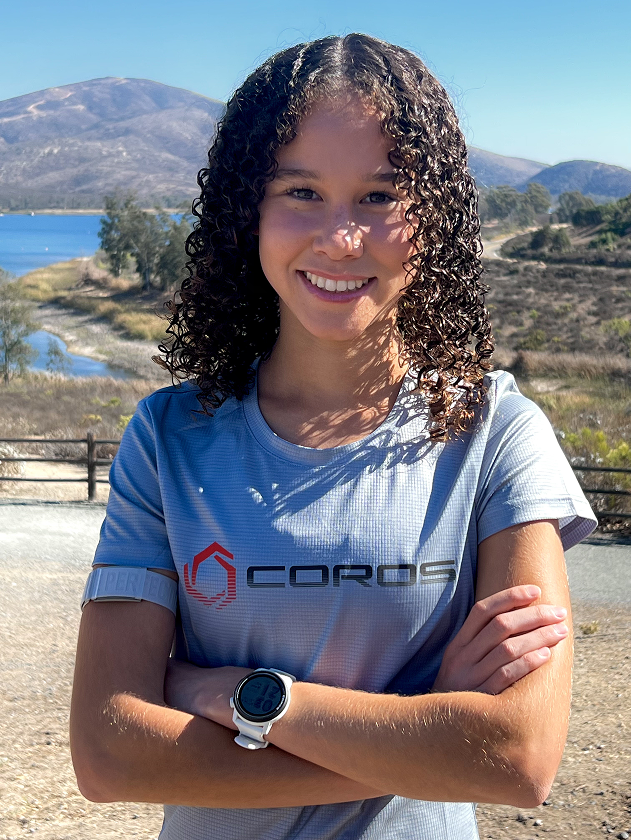
The indoor season is wrapping up, with just the Mile and 5000m at New Balance Nationals remaining. After that, Williams turns her attention back to the outdoor track and the long championship season that lies at the end. Arcadia is early on the calendar, with CIF championships beginning in May.
Her focus will remain on the two-mile as her primary event, with more mile racing mixed in this year. But the approach stays the same: build the base, trust the training, and let the fitness come.
"I'm mostly going to focus on training and just building," she said. "And then I'll transition into my championship phase when those races start."
After what she accomplished on her first-ever trip to the East Coast, the outdoor season should be something special.
Jaelyn is a member of COROS NextGen, a program which aims to work with elite high school athletes as they push their boundaries to become the next generation of elite distance runners in the U.S. For any high school athlete chasing their best, head to www.coros.com to learn more on products, training tips, and insights from athletes of all levels.