/filters:quality(90)/fit-in/970x750/coros-web-faq/upload/images/db6f389a92c12470b0060d8fa1e4a758.png)
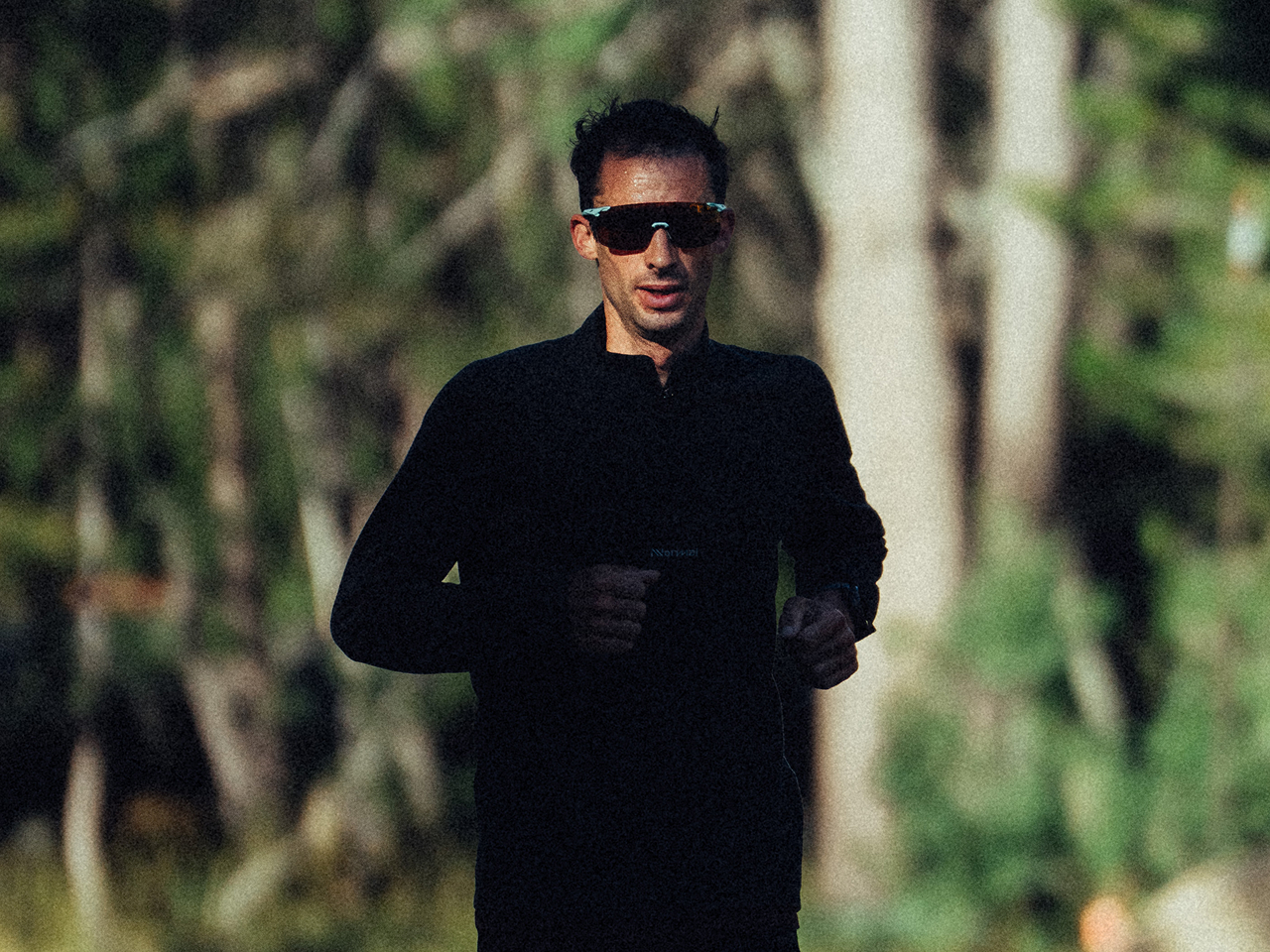
COROS is thrilled to welcome Olympian and World Indoor medalist Nikki Hiltz to the team. This season, Hiltz is chasing something new: a fast time at the Prefontaine Classic, with the American Record squarely in their sights. Behind that pursuit is a deliberate, hard-won approach to training. Here's an inside look at how Hiltz builds toward a day like that.
What Makes Nikki One of the Best in the World
Nikki races with a kick that's become a calling card. "I don't know what it is. I just see the finish line and something comes out of me," they say. It has always been there. Nikki's high school coach noticed it early on, and they've continued to develop it ever since.
But for a stretch of their career, that kick could only carry them so far. "I had my kick, I had my speed, but I didn't necessarily have the strength to be there at the end to use it. Whenever it was a 4:05 to 4:02 type race, I could do it. But as soon as it was sub-4, I was out." That weakness surfaced at the worst possible moment: a fast championship race where Nikki wasn't a factor at the finish.
Following that season, Nikki saw opportunity and made big changes. "Finding things I can improve actually gets me excited. I'm like, oh my gosh, yes — if I get a little bit better at this, maybe that's the missing piece I need."
They hired a new coach and moved to Flagstaff, Arizona, in hopes that altitude would add the strength that was missing. Since then, Nikki has been a powerhouse on the homestretch of every race they're in.
What a Typical Season Build Looks Like
Hiltz's season starts with a single question, what's the biggest goal, and what does it take to get there? This year, the answer reaches further than usual. "I'm very intentionally going for a fast time at Pre, and I've never really done that before — putting a record out there and chasing it. I've always been someone who competes more than chases fast times, so this is a fun new thing for me."
Getting there is still built backward from the championship calendar. "I ask, what's the goal for this year — usually it's a World Championships or an Olympics — and then I work backward from there." Pre sits right in the middle of that build. The meet is a Diamond League fixture that doubles as the stage for Nikki's American Record attempt.
The season often features clusters of races, where Nikki competes frequently for about a month before diving back into a heavier training block.
What a Typical Week Looks Like
Regardless of how the season shifts, the architecture of Nikki's week doesn't. Only the paces change as the year progresses and key races approach. Their training follows a seven-day cycle that repeats nearly identically from base phase through peak fitness.
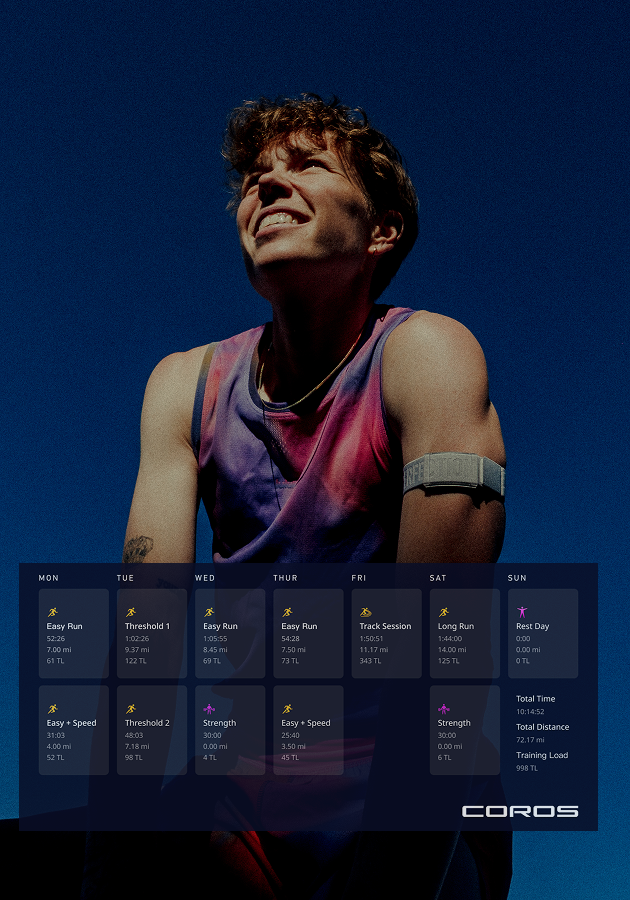
Monday and Thursday each have two easy runs, with speed development drills after. Tuesday is double-threshold day. Wednesday is a midweek longer run. Friday is the hardest day of all: a highly specific track session designed to simulate exactly what a championship race demands. Saturday brings a 14-mile long run, and Sunday is completely off — no exceptions. "I have one off day every week, and I think it really saves me, especially living up here at 7,000 feet. No matter what, on Sunday I'm not training, and I don't have to think about running."
Strength work fills the gaps in between, with lifting on Wednesdays and Saturdays. Sessions are heavier in base months, shifting toward plyometrics and explosive work as race season arrives. With such high-load workouts on the schedule each week, these are the glue that keeps everything together. "I swear, every time I accidentally skip a weight session, some little niggle pops up the next week. It's how I stay healthy. I'm married to it."
Sessions Worth Watching
Nikki's most intense days are Tuesday & Friday. On Tuesdays, they run a threshold workout in the morning, and another threshold workout in the afternoon. Each session contains roughly 4-6 miles of work at threshold pace, broken into reps that could span anywhere from 400m to 2mi.
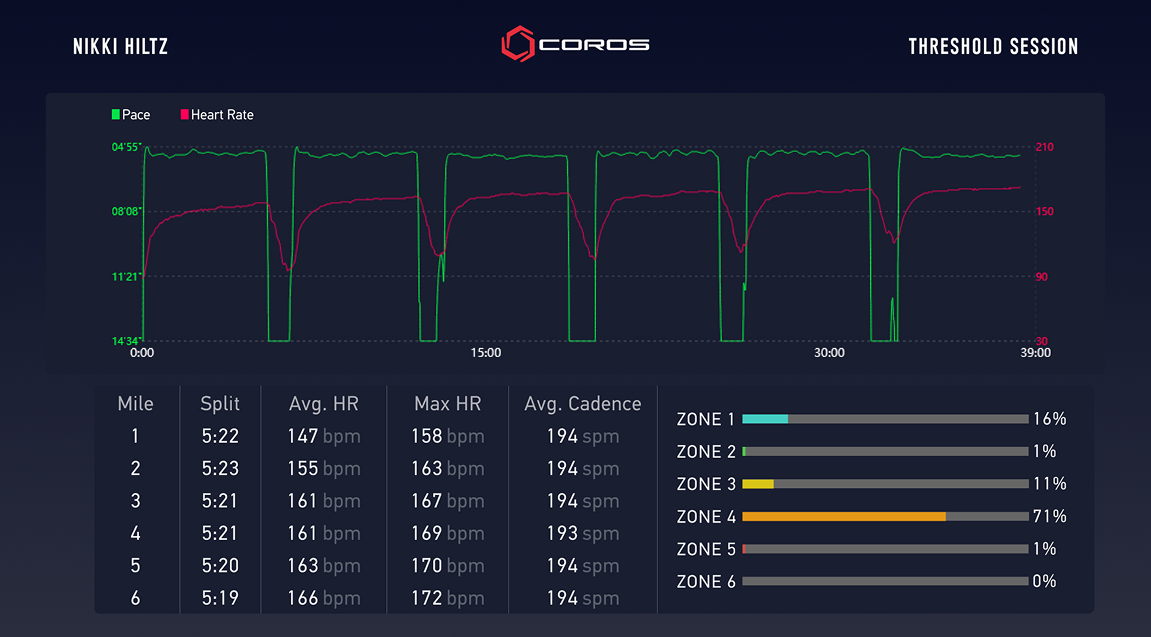
One recent double-threshold day consisted of 6xMile in the morning (shown above), and 4xMile in the afternoon, each with 1 minute of rest in between. These workouts are primarily about accumulating time in Zone 4, providing enough metabolic stimulus to keep their aerobic strength where they need it to be.
Threshold days run on feel, adjusting to account for wind, fatigue, and altitude. "Threshold is a feeling. My pace might be 5:20, but if my legs feel like trash from a race the weekend before, today's threshold might be 5:26."
Fridays flip that logic entirely. Exact splits become the name of the game. "We're not chasing a feeling on Fridays — you lock in behind your pacer and go. That's exactly how a race goes sometimes, too." The sessions building toward key races like Pre are the most specific of the year. Ask Hiltz what a Friday workout looks like, and the honest answer is: it's complicated. "I can't even tell you what a typical Friday workout looks like, because it's so specific — it's never just 12x400. It's like a 300, then a 600, with this rest, then an 800, always something very fine-tuned toward what we're working on. I like it. It makes it feel like we're working toward something."
Increasingly, these sessions double as rehearsal for the surges that define modern Diamond League racing. Nikki frequently practices how to respond when a competitor throws a sudden 60-second lap into the middle of a race. "You have to practice feeling that in a workout so you can respond to it when it actually happens."
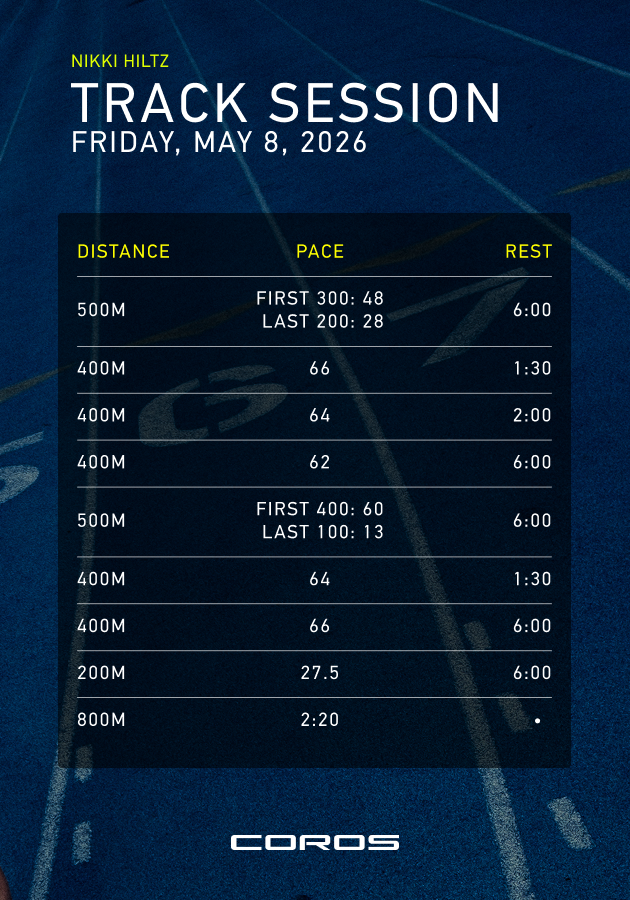
Even at first glance, this workout is noticeably complex. The workout contains 8 different paces, sometimes making a change mid-rep. Those gear-changes in the 500s are a common inclusion on Fridays. They help keep Nikki's kick sharp and deadly. On every rep, the splits are precise, just as they need to be in a race. Falling 1 second behind can be the difference between winning and missing the podium, so Nikki hits their splits every time, rain or shine.
The Tuesday and Friday sessions couldn't be more different. Nikki's threshold days are run by feel, simply designed, and easily repeatable. Fridays are meticulously paced and highly specific towards developing a skill for track & field's most tactically complex event.
When Hiltz lines up at the Prefontaine Classic this season, it'll be the product of everything above: a kick that's always been there, a strength they found in Flagstaff, and a season built deliberately toward one fast afternoon at Hayward Field. That's exactly the kind of athlete we're proud to welcome to COROS. Welcome to the team, Nikki — we'll be watching closely at Pre.